Moss Lawns: A Low-Maintenance Revolution for 2025 Landscapes
Examine your yard and observe the persistent challenges. Uneven grass patches, relentless mowing demands, and irrigation routines exhaust even committed gardeners. Many individuals seek a gentler alternative that aligns with natural conditions. Moss lawns emerge as an ideal solution, delivering verdant coverage without the rigors of conventional turf. Increasing numbers of property owners embrace moss for its serene, undemanding presence that enhances yard vitality.
Evaluate Your Yard for Moss Potential
Commence by strolling through your property. Identify zones where grass falters, such as shadowed nooks, sparse areas beneath trees, or persistently wet sections. These features often frustrate efforts for uniform turf, yet they suit moss perfectly. Moss flourishes amid humidity and low light, transforming overlooked spaces into assets.
This assessment reveals opportunities amid obstacles. Rather than imposing fertilizers or repeated sowings against environmental realities, collaborate with them. Such a perspective fosters equilibrium, allowing the landscape to evolve harmoniously.
Benefits of Adopting Moss Lawns
Moss lawns represent more than aesthetic preference; they signify a commitment to reduced labor and environmental synergy. Moss demands no mowing, fertilization, or frequent irrigation. Established patches remain vibrant throughout seasons and provide a plush surface for traversal. For those weary of upkeep cycles, moss delivers respite and insight.
Consider these key advantages that attract property owners:
- Minimal Upkeep – Eliminate weekly cutting in favor of occasional debris clearance and targeted watering during extended droughts.
- Environmental Advantages – Bypass gas-operated equipment and synthetic treatments to lower emissions and water usage.
- Aesthetic Appeal – Achieve a uniform, restorative green hue that tempers stark lines and promotes tranquility.
- Adaptability – Excel in shaded, compacted soils where turf deteriorates.
The essence of moss lawns involves strategic restraint, empowering natural processes to prevail.
Prepare the Site for Moss Establishment
Initiate the transition with straightforward groundwork. Remove existing turf, weeds, and litter to expose bare earth, facilitating moss adhesion. Unlike rooted grasses, moss secures via rhizoids, emphasizing surface preparation over soil depth.
Next, scarify the ground lightly using a rake to create texture for attachment. Distribute moss fragments or transplants across the site, then compress them into the soil and apply a fine water spray. Maintain consistent moisture for initial weeks through daily misting. Subsequently, environmental factors assume primary responsibility.
Moss favors acidic conditions, typically pH 5.0 to 6.0. Conduct a soil test kit analysis to verify levels. If adjustment proves necessary, incorporate elemental sulfur at 1 to 2 pounds per 100 square feet or layer pine needles for gradual acidification. As moss colonizes, such interventions diminish in frequency.
Select Appropriate Moss Varieties
Moss species vary in preferences, influencing success rates. Match selections to site specifics for optimal growth with limited intervention.
- Hypnum Moss expands uniformly, forming a seamless mat suited to mild inclines or covered walkways.
- Leucobryum Moss develops cushioned clusters, introducing varied contours ideal for ornamental zones.
- Dicranum Moss adheres well to rocks or timber, enhancing rugged designs.
- Thuidium Moss exhibits delicate fronds, complementing forested or perimeter plantings.
Begin with modest trials across test areas to gauge performance. Moss propagation occurs gradually, highlighting compatible niches over time.
Maintain Your Moss Lawn Effectively
As moss takes root, shift focus to monitoring rather than intensive tasks. Prioritize clearing fallen leaves or twigs with a flexible rake or broom to prevent smothering.
Irrigate solely during prolonged arid phases, applying 0.5 inches of water weekly if foliage dulls. Moss draws humidity from atmosphere, sustaining itself in temperate regions. Refrain from excess moisture, which invites competing vegetation.
Address weeds manually upon emergence, leveraging moss density as a natural barrier. This method renders control infrequent compared to turf management.
Incorporate Moss into Broader Designs
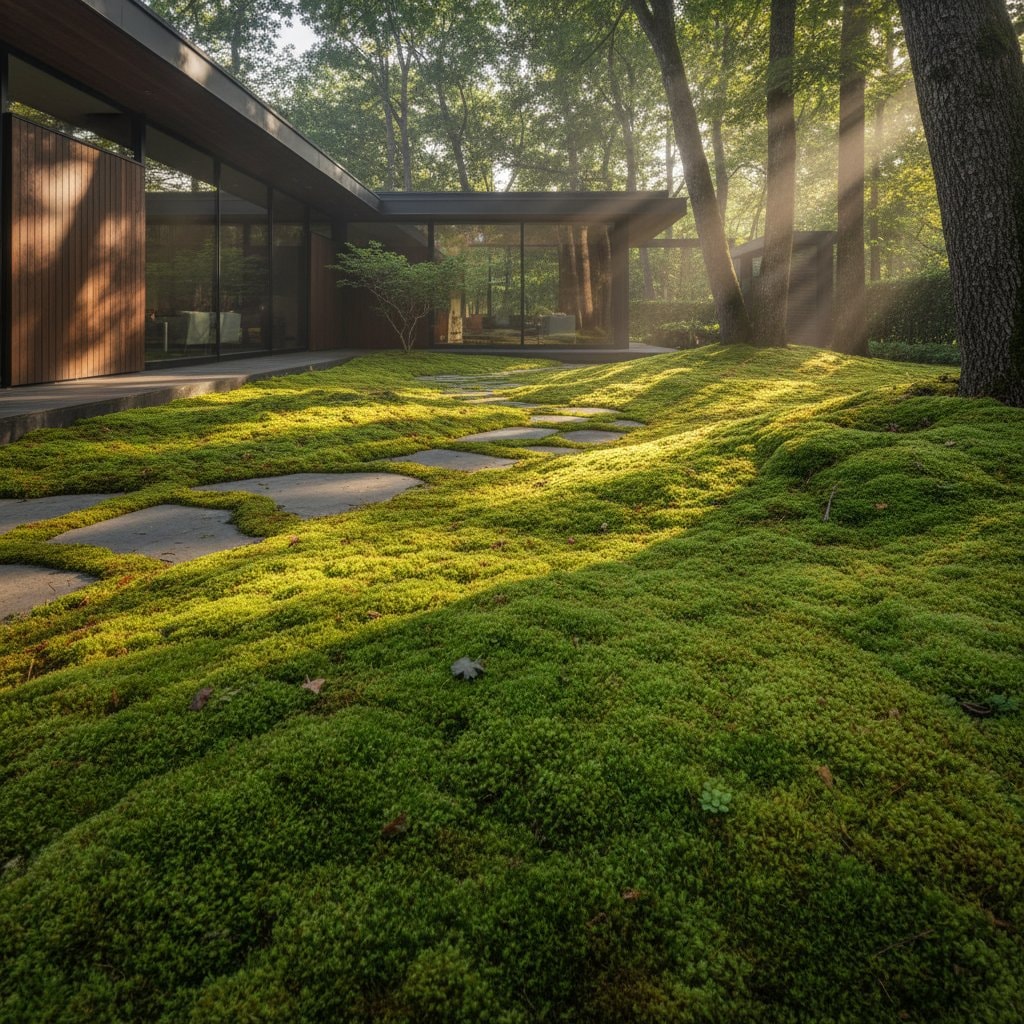
Moss need not supplant all grassy expanses. Employ it strategically to bridge flower borders, encircle pavers, or underlay arboreal canopies. It tempers gravel routes or delineates seating areas with subtle framing.
Combine with companions like thyme or bugleweed for textural diversity while preserving simplicity. Alternate moss strains to yield nuanced green tones, crafting intricate patterns.
This integration yields a dynamic composition, encouraging seasonal observation and appreciation.
Debunk Misconceptions Surrounding Moss Lawns
Hesitation often stems from outdated beliefs. Address these to build assurance:
- Misconception: Moss destroys turf. Moss occupies niches unsuitable for grass, such as low-light, high-moisture locales, without aggressive invasion.
- Misconception: Moss creates hazards. Healthy moss offers gentle footing; ensure adequate runoff to avoid pooling.
- Misconception: Moss lacks durability. It withstands moderate use, animal activity, and climate shifts resiliently.
- Misconception: Moss requires perpetual dampness. It tolerates dry periods by dormancy, rebounding with precipitation.
These clarifications empower informed decisions.
Experience the Serenity of a Thriving Moss Lawn
Observe as moss expands, infusing the area with composure. Its yielding texture beckons leisurely strolls and contemplation. Time outdoors increases, captivated by unadorned poise. Maintenance recedes, yielding to fulfillment in a nature-compliant haven.
Embrace Simplicity for Lasting Landscape Rewards
Opting for moss transcends mere selection; it cultivates deliberate horticulture. Release exhaustive routines to welcome resilient, elegant growth.
Allow time for progression. Moss advances deliberately, enveloping and refining the terrain into a restorative sanctuary. Each visit underscores vitality's potential in unobstructed settings.