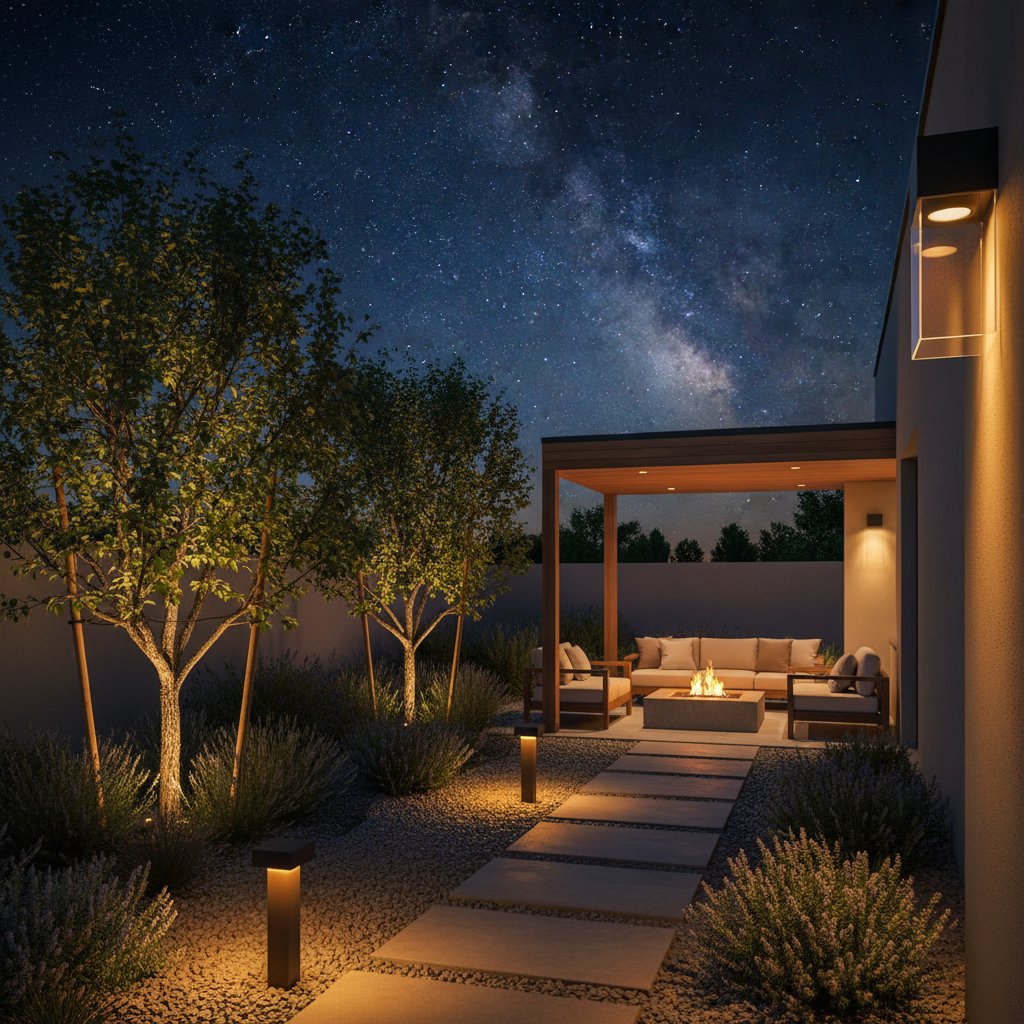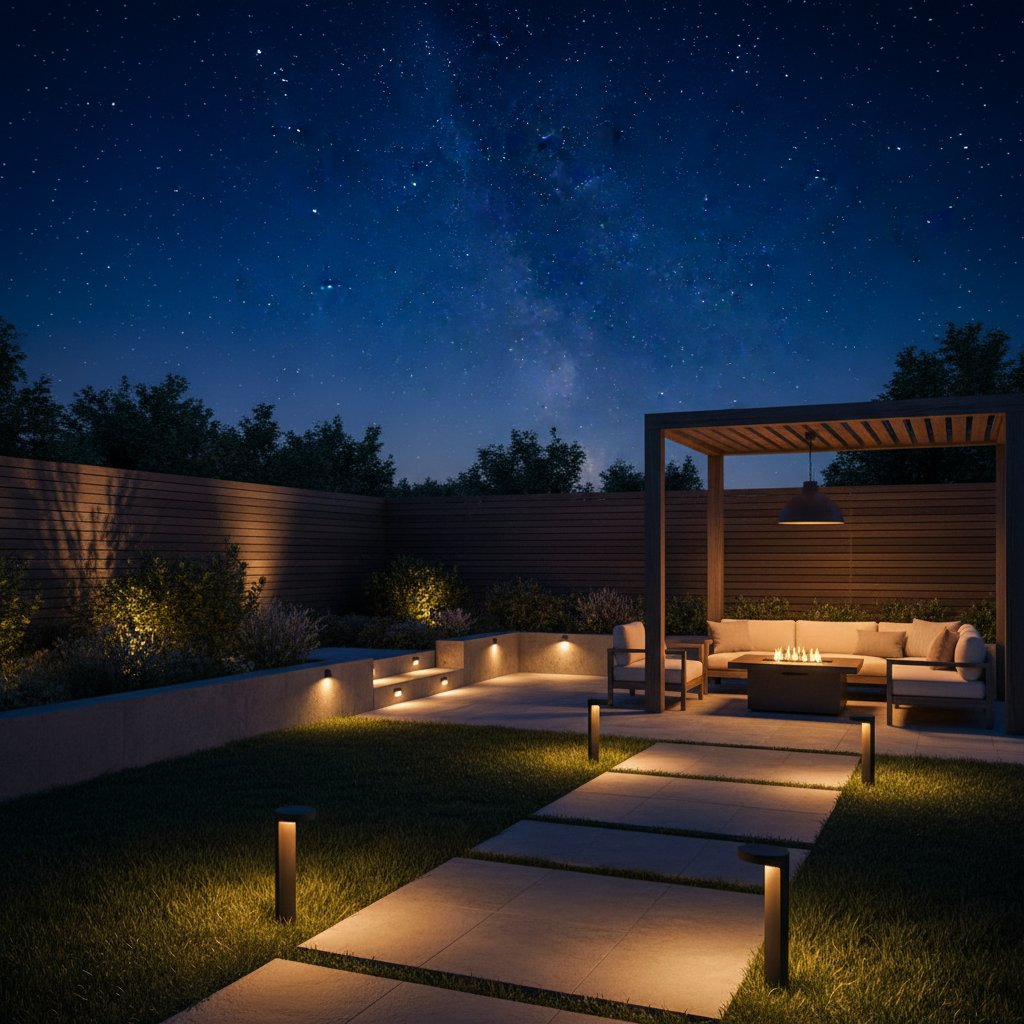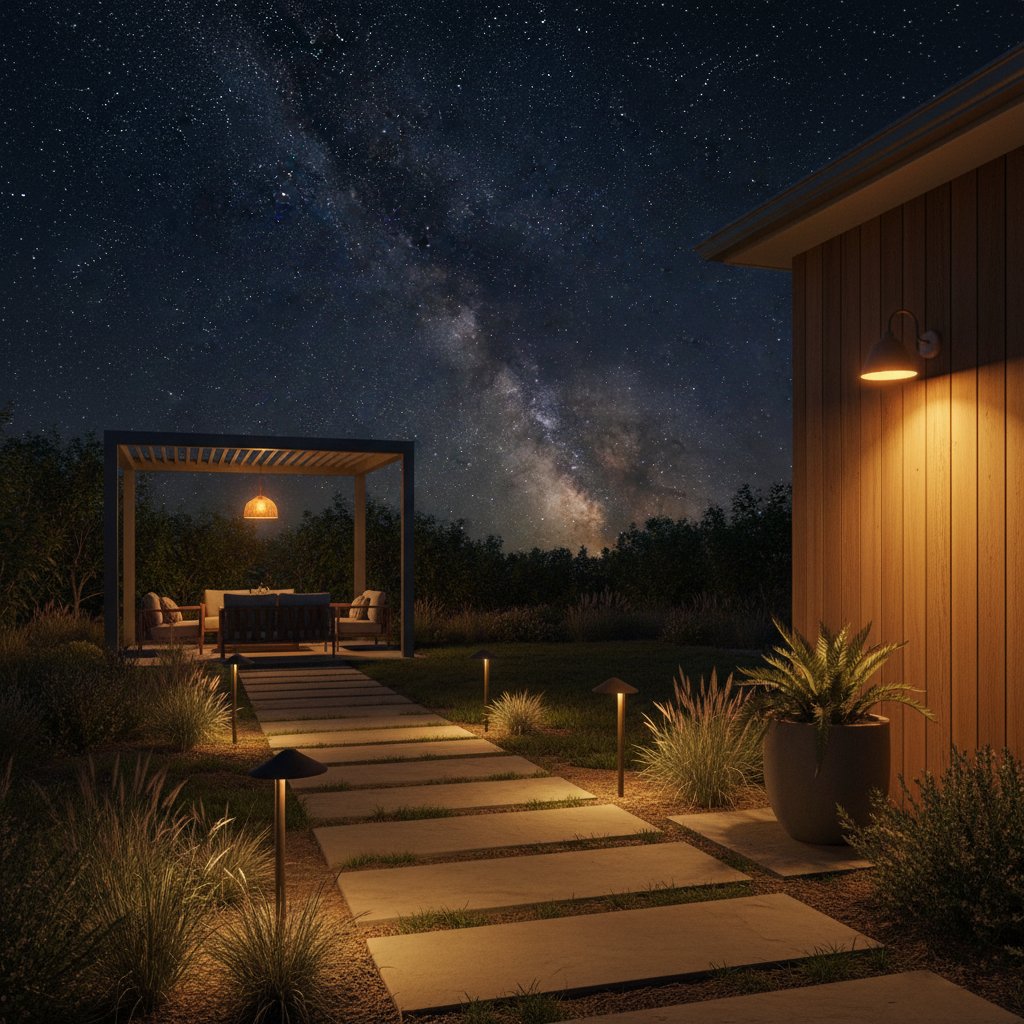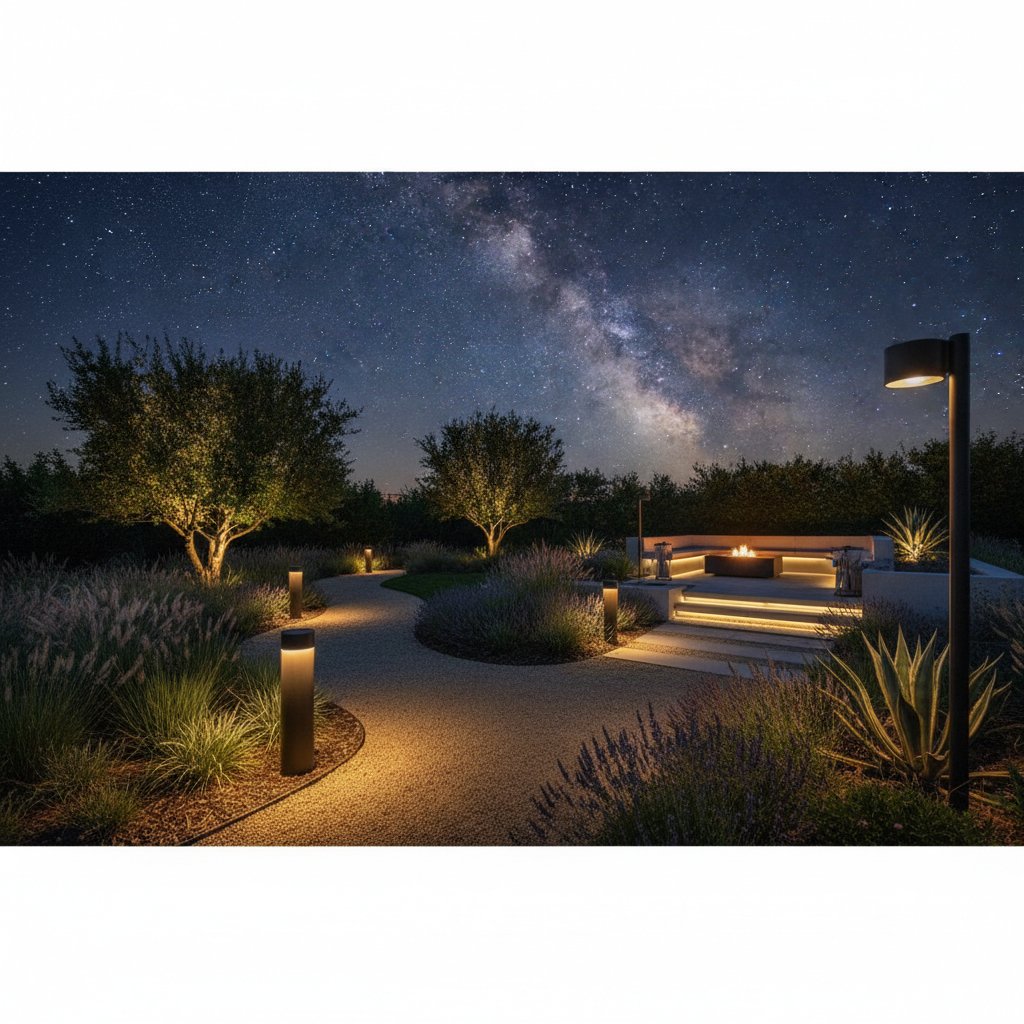
Stunning Outdoor Glow Without Light Pollution
The most memorable gardens encourage visitors to remain after sunset. Light that gently touches a stone wall, reflects on water, or outlines leaves creates a subtle enchantment. Harsh outdoor lighting, however, can diminish this effect by overwhelming the night sky. Effective illumination guides without glaring and fosters atmosphere while preserving visible stars.
Dark-sky lighting achieves this equilibrium. This approach designs outdoor illumination to honor the landscape and the natural night. Gardens illuminated in this manner enhance beauty while minimizing disturbance to wildlife and neighbors.
Understanding Light Pollution in the Landscape
Light pollution occurs when artificial light extends beyond its intended area. Such spillover illuminates the night sky, obscures stars, and disorients nocturnal animals dependent on darkness for feeding, migration, or rest. In residential settings, it intrudes into homes, disrupting sleep or causing glare.
From a distance, urban or suburban areas often exhibit a hazy glow overhead. This phenomenon results from fixtures that direct light upward or omnidirectionally instead of concentrating it downward. Homeowners frequently overlook how quickly this develops; a single unshielded floodlight on a driveway, for instance, scatters light across the sky and adjacent properties.
Decorative garden lights contribute similarly if improperly positioned or unshielded. Dark-sky lighting addresses this by targeting illumination precisely where required.
The Principles of Dark-Sky Lighting
A dark-sky compliant garden emphasizes moderation over abundance. Success lies in selecting appropriate fixtures and applying them strategically. Key principles include:
- Direct light downward. Opt for fixtures equipped with shields or hoods that channel illumination toward the ground, avoiding outward or upward dispersion.
- Employ minimal brightness levels. Warm, subdued light suffices for pathways, patios, and seating zones.
- Restrict fixture quantity. Strategically placed units generate greater ambiance than numerous high-intensity ones.
- Deactivate lights when unused. Incorporate timers or motion sensors to eliminate superfluous glow.
- Choose warmer color temperatures. Tones around 2700K to 3000K remain contained and less prone to atmospheric scattering than cooler blues or whites.
These guidelines promote intentional design that values nocturnal serenity and communal comfort.
Choosing Fixtures That Work With the Night
Fixture selection influences the overall light quality in outdoor spaces. Numerous manufacturers produce dark-sky compliant options, certified for low upward light emission. Variations in aesthetics and utility remain broad.
Path lights suit walkways and borders. Select models with downward-oriented shades that conceal the light source, providing even path illumination without stark spotlights.
Wall-mounted sconces enhance entryways or patios. Prioritize designs that cast light downward and outward modestly, forming a localized pool near entrances while minimizing yard shadows.
Recessed step lights ensure safety with inherent subtlety. Integrated into walls or stairs, they inherently curb light diffusion.
Spotlights and uplights demand cautious application. To accentuate trees or sculptures, mount units near ground level with focused beams; restrict to narrow angles and low wattage to prevent glare.
String lights and lanterns build coziness when applied judiciously. Install low-lumen bulbs and position near seating or pergolas, avoiding elevated placements in trees or along eaves that foster sky glow.
The Power of Subtle Illumination
Effective lighting design prioritizes restraint as much as visibility. Subtle applications spark interest and guide the gaze organically through the space. Textures and shapes reveal themselves gradually rather than under uniform brightness.
In dark-sky gardens, subtlety directs the approach. Illuminate select elements like paths, water features, or lounging spots; permit shadows to envelop the remainder, with moonlight and stars providing ambient fill.
View the garden as composed of distinct vignettes. Each requires measured light for navigation and comfort, not dominance. Examples include:
- Stone pathways illuminated by bollards spaced 6 to 8 feet apart for continuous yet soft guidance.
- Small ponds enhanced by one or two submerged LEDs directed centrally to evoke gentle ripples.
- Patio dining areas supported by a single overhead pendant plus supplemental candles for layered warmth.
Such targeted accents unify the scene into a tranquil whole.
Blending Form and Function
Dark-sky lighting integrates environmental consideration without sacrificing elegance. Properly executed, it refines the broader outdoor aesthetic. Fixtures double as daytime ornaments and nocturnal enhancers.
Match materials to the site's character: aged bronze or copper patinas for rustic appeal, matte black for contemporary minimalism, or stone and wood for seamless natural integration.
Strategic placement aligns with architectural and spatial elements. Along winding paths, deploy low-profile lights to trace contours; in formal layouts, employ symmetric arrays for cohesion. Consistent motifs reinforce purposeful harmony.
Avoiding Common Lighting Mistakes
Outdoor lighting challenges often arise from excess rather than oversight. Assumptions that increased brightness bolsters security or allure prove counterproductive. Frequent errors encompass:
- Over-illuminating paths or driveways. Excessive fixtures produce blinding glare that impairs vision.
- Selecting bright white bulbs. These tones appear stark and exacerbate sky pollution.
- Neglecting shielding. Visible sources strain eyes and squander energy.
- Illuminating all elements uniformly. Overlit uniformity diminishes focal points.
Test installations incrementally: activate a minimal set at dusk, evaluate spill and interactions with foliage or structures, then refine. Additions prove simpler than reductions post-installation.
Balancing Safety and Ambience
Secure outdoor areas after dark remain a priority for all homeowners. Controlled lighting reconciles visibility with sensory comfort.
For stairs, driveways, and entrances, apply uniform low-intensity illumination to delineate edges and level shifts. This approach eases eye adaptation and averts mishaps.
In expansive lawns or beds, embrace shadow for contrast. Dimmed peripheries accentuate lit zones, rendering paths and patios more inviting.
Motion sensors optimize this balance by maintaining darkness until activated, conserving power and limiting wildlife impact.
Designing With Nature in Mind
Dark-sky practices extend benefits beyond stellar views to ecological support. Nocturnal species rely on light-dark cycles for foraging and breeding; excess light disrupts these patterns.
Amber-hued bulbs (around 2200K) disturb less than stark whites. Downward-directed shielding further mitigates interference. Properties adjacent to woods or fields benefit from unlit borders to preserve wildlife pathways.
Incremental adjustments yield results: swap a floodlight for a hooded wall unit or reduce wattage by 50 percent to alleviate ecosystem pressure.
Creating a Garden That Glows Gently
Enduring nighttime gardens evoke serenity through balanced light and shadow interplay. Rhythm and repetition underpin this outcome.
Maintain uniform fixture aesthetics across the landscape for cohesion. Consistent warm tones unify disparate zones. Assign distinct roles to each light, practical or ornamental.
Incorporate non-electric sources like fire pits or tiki torches for dynamic, ground-level warmth that aligns with dark-sky tenets.
Traversing such a garden reveals night's profundity: enhanced celestial clarity, tranquil air, and vivid plant contours under diffused radiance.
Living With Your Design
Post-installation, engage with the setup on multiple evenings. Assess whether highlights align with intentions and if glare or spillover occurs.
Fine-tune angles or elevations as required; seasonal plant growth alters shadow patterns. Routine upkeep preserves efficacy.
Wipe fixtures, prune obstructing growth, and verify controls to sustain subtlety and appeal. Iterative observation refines the scheme to match preferences.
Implementing Thoughtful Outdoor Illumination
Dark-sky lighting transforms gardens into respectful nocturnal havens. Prioritize deliberation over opulence to illuminate sustainably.