Illuminate Your Yard Without Polluting Skies
Clear nights offer a profound quiet, with the subtle scent of grass and the gentle hum of crickets providing peace that daytime seldom matches. This tranquility often shatters under the beam of a misplaced floodlight or an upward-glaring garden lamp. Homeowners frequently install outdoor lights to foster beauty and security, yet these efforts can erase stars and disturb natural outdoor rhythms. Light itself poses no threat to darkness; proper guidance ensures harmony.
Dark-sky lighting design achieves this equilibrium. It enables nighttime enjoyment of your yard while safeguarding the celestial view overhead. This approach serves as both an aesthetic and environmental strategy, reshaping post-sunset landscapes. Residents of suburban areas or rural settings alike benefit from mastering illumination that respects the skies.
Understanding Light Pollution at Home
Light pollution extends beyond urban centers; it arises wherever illumination spills unnecessarily. The hazy glow over communities stems from countless minor light sources. On a residential level, this manifests as porch lights intruding on neighbors' windows, path lamps beaming skyward, or decorative units casting stark, cool radiance across lawns.
Several forms of light pollution demand attention to inform superior design:
- Glare: Intense, unshielded brightness that impairs vision, inducing discomfort or brief disorientation as eyes adapt.
- Skyglow: The luminous dome over settlements, resulting from atmospheric light diffusion.
- Light trespass: Unintended spillover into undesired zones, like interiors or adjacent properties.
- Clutter: Overabundant bright sources generating visual disarray.
Targeted fixture selection and positioning mitigate each issue. Effective lighting transcends mere appearance; it honors communal skies and ecological balance.
The Principles of Dark-Sky Lighting
Dark-sky lighting directs beams precisely to required areas, excluding the sky. The objective remains grounded illumination. Though straightforward in concept, implementation demands deliberate planning and moderation.
Key principles include:
-
Employ fully shielded fixtures: Opt for units with opaque tops and sides that channel light downward. Steer clear of exposed bulbs or omnidirectional designs.
-
Maintain modest brightness: Subdued radiance proves more practical than intense rays. Night-adapted eyes thrive in lower intensities, yielding greater comfort.
-
Choose warm color temperatures: Spectrum hues like amber or warm white integrate seamlessly with nocturnal settings. Such tones convey warmth over severity.
-
Activate light selectively: Integrate motion detectors and timers to limit usage to essential moments. This practice curtails energy consumption and upholds evening serenity.
-
Control installation angles: Fixture orientation dictates beam distribution. Improper tilts readily propel glare aloft.
Adhering to these guidelines fosters a nuanced strategy addressing utility and elegance. It bolsters nocturnal wildlife, which depends on unlit conditions for orientation and foraging.
Choosing Fixtures with Purpose
Appropriate fixtures form the core of superior outdoor setups. Each unit fulfills a specific role; clarifying that role prevents excess or errors in positioning.
Path Lights
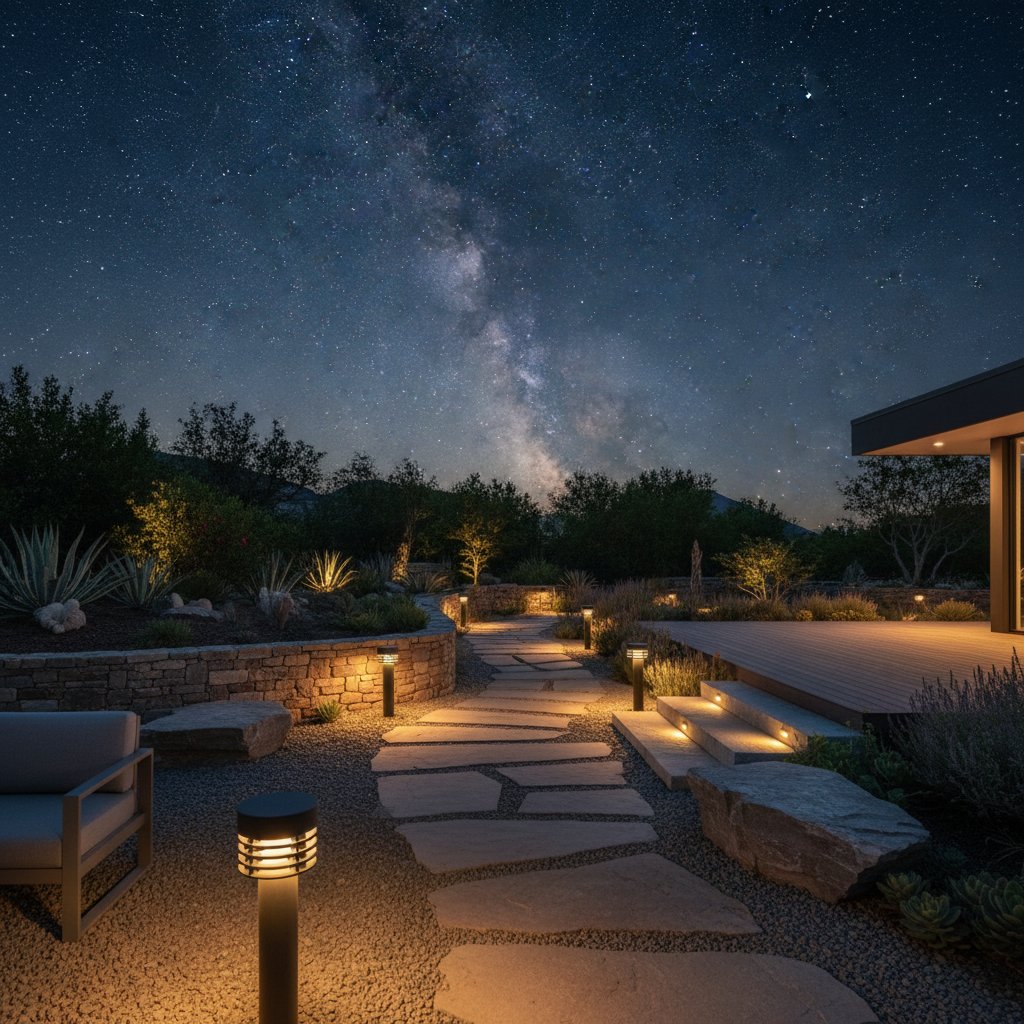
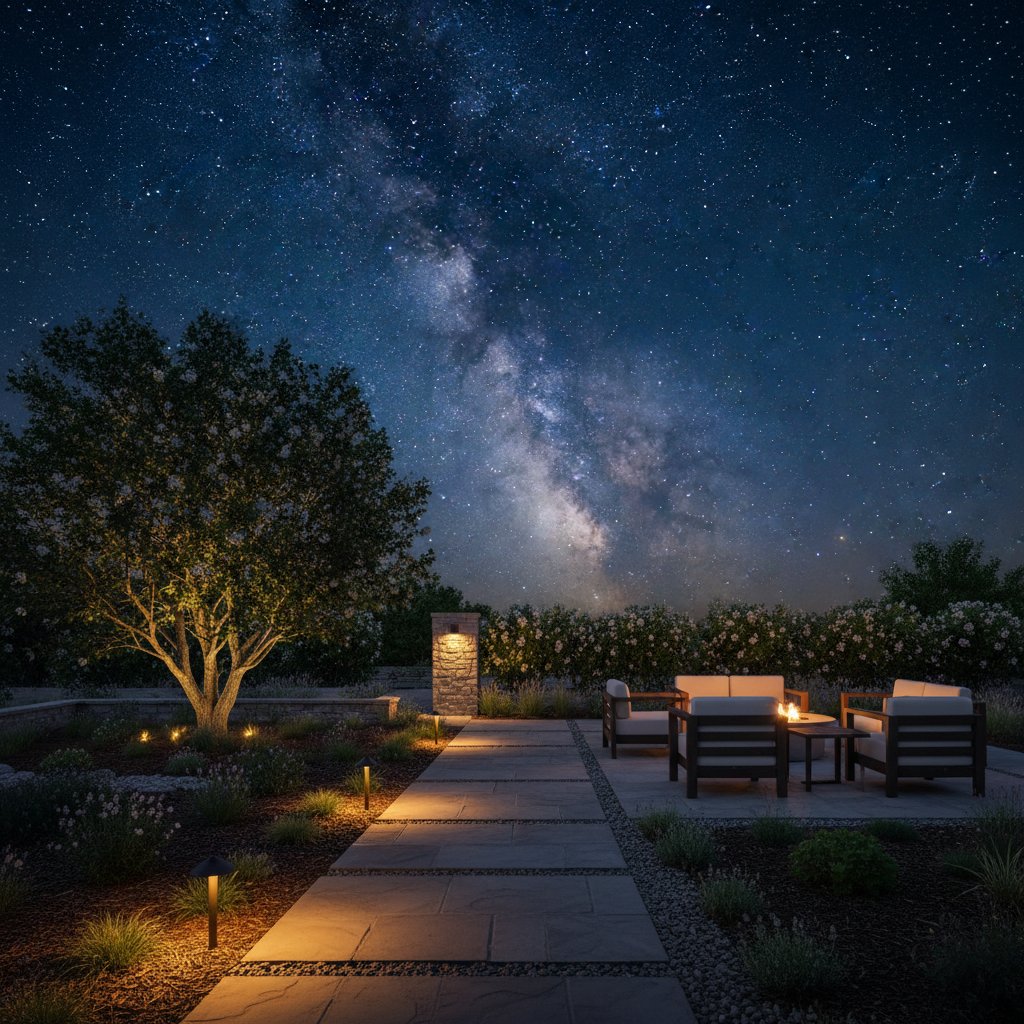
Path lights facilitate safe traversal across the yard. Position them near ground level with shields blocking lateral or vertical escape. Compact domed models suffice, offering visibility for footing without inducing discomfort.
Wall Lights
Affix these to walls or fences to accentuate structures or illuminate entrances softly. Select variants that cascade light along surfaces rather than projecting broadly. A diffused surface glow elevates sophistication beyond stark highlights.
Spotlights and Uplights
These accentuate foliage, artwork, or beds, though misuse invites pitfalls. Direct beams to terminate at targets, avoiding overshoot. Employ reduced-wattage sources or focused spreads to curb atmospheric diffusion.
Step and Recessed Lights
Embed these in stairs, barriers, or platforms for hazard-free navigation with minimal visibility. Surface integration ensures negligible contribution to overhead haze.
String Lights and Decorative Fixtures
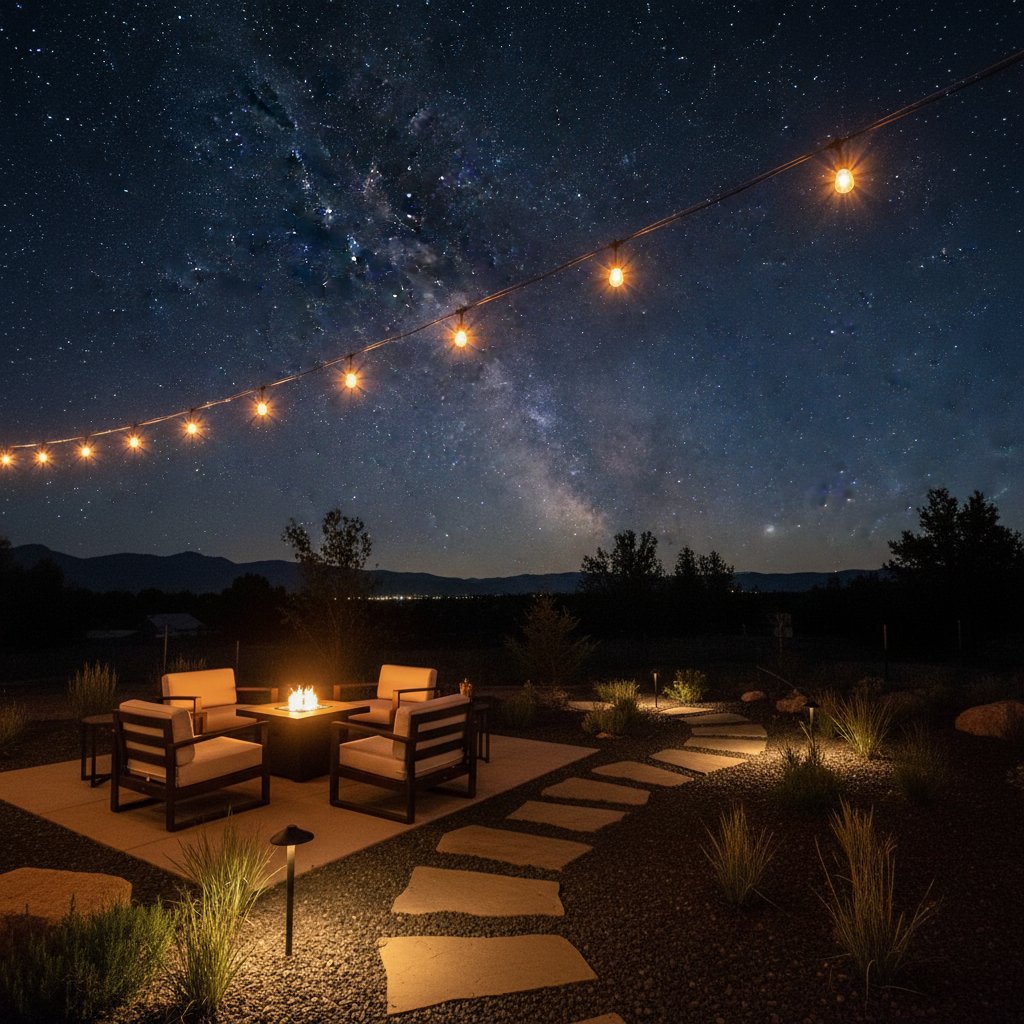
Ideal for patios during events, these risk excess if prolonged overnight. Deploy judiciously, favoring diffused, muted variants.
Purposeful choices yield intentional nighttime vistas. Gentle focal points emerge, guiding gazes fluidly across the space.
Balancing Beauty and Function
Light functions akin to stone or timber in design, molding mood and form. Restraint defines success; excess flattens, while nuance sparks intrigue. Selective illumination suffices over comprehensive coverage, leveraging shadow for depth.
Consider layered applications:
- Functional lighting: Ensures secure passage and task support.
- Accent lighting: Spotlights focal elements such as arbors, plantings, or lounges.
- Ambient lighting: Builds overall tone via bounced or scattered beams.
Balanced schemes rely on fewer elements than anticipated. A single wall cascade might supplant several paths; one arboreal accent could delineate a zone. Prioritize excellence over volume.
During planning, traverse the yard nocturnally with a portable light. Identify natural pathways, hesitation points, and visual draws. These insights pinpoint essential and enhancing placements.
The Connection Between Light and Ecology
Artificial illumination profoundly impacts ecosystems, a fact overlooked by many. Fauna adhere to innate photoperiods; overlighting fractures these patterns. Insects like moths exhaust against lures, while avian migrants veer off course amid obscured constellations.
Vegetation also reacts; persistent glows disrupt phenology, particularly in photoperiod-sensitive varieties. Thoughtful restraint not only clarifies stellar vistas but nurtures local biodiversity. Yards that shimmer subtly integrate with environs, eschewing rivalry.
Simple Ways to Reduce Light Pollution Right Now
Immediate improvements require no full redesign. Incremental tweaks yield swift gains.
- Replace bulbs: Substitute high-lumen cool whites with warmer, dimmer alternatives.
- Install shields: Retrofit current units to redirect beams earthward.
- Incorporate automation: Program timers or smart systems for off-peak shutdowns.
- Readjust positions: Minor angle corrections often eliminate glare or intrusion.
- Assess remotely: View setups from afar, including streets and borders, to detect overlooked spills.
Such measures suit all properties, trimming costs and prolonging components.
Finding Inspiration in Darkness
Darkness enriches rather than repels in landscapes, lending context to light. Illuminated routes amid veiled plantings evoke enigma. A moonlit silhouette against stars captivates more than bathed uniformity.
Experience unlit evenings outdoors. Allow adaptation; observe lunar interplay on foliage or branch outlines. Subsequent additions should echo this repose, not supplant it.
Superior schemes attune to nocturnal essence, rendering light unobtrusive. Stars retain prominence in such realms.
Living with Your Design
Post-installation, monitor the system across conditions before alterations. Moisture or mist alters reflections, amplifying perceived intensity. Seasonal tweaks in timing and aim accommodate routines and growth.
Routine upkeep sustains dark-sky adherence. Inspect alignments and clarity periodically; drifts invite reversal. Aging sources may shift hues, impacting ambiance.
View lighting as an evolving garden facet. Adaptability preserves core tenets amid flux.
Implementing Dark-Sky Harmony
Starlit serenity commences with observation. Evaluate existing setups: Do they beckon or repel? Do they augment or overshadow natural glow?
Apply principles incrementally for enduring rewards. Your yard becomes a haven blending allure, safety, and ecological grace, inviting endless evenings under unmarred skies.