Decomposed Granite: The Leading Material for 2026 Patio Designs
Homeowners planning patio upgrades should consider decomposed granite as a primary option. This natural substance gains prominence in modern outdoor areas due to its visual appeal, economic value, and straightforward upkeep. Decomposed granite adapts to diverse styles, from streamlined minimalist layouts to relaxed garden havens, while aligning with various financial plans.
Understanding Decomposed Granite
Decomposed granite, commonly abbreviated as DG, derives from weathered granite fragments reduced to finer particles. Its composition yields a sandy, mildly coarse texture that compacts densely yet permits effective water drainage. Available in hues such as gold, tan, gray, and reddish-brown, it readily coordinates with architectural elements and environmental surroundings.
In contrast to loose gravel, decomposed granite forms a stable, solid footing upon compaction. This feature minimizes shifting, enabling confident navigation without discomfort from sinking or slippage. Such reliability explains its repeated selection by residential owners and professional landscapers for patios, walkways, and edging applications.
Alignment with Contemporary Outdoor Aesthetics
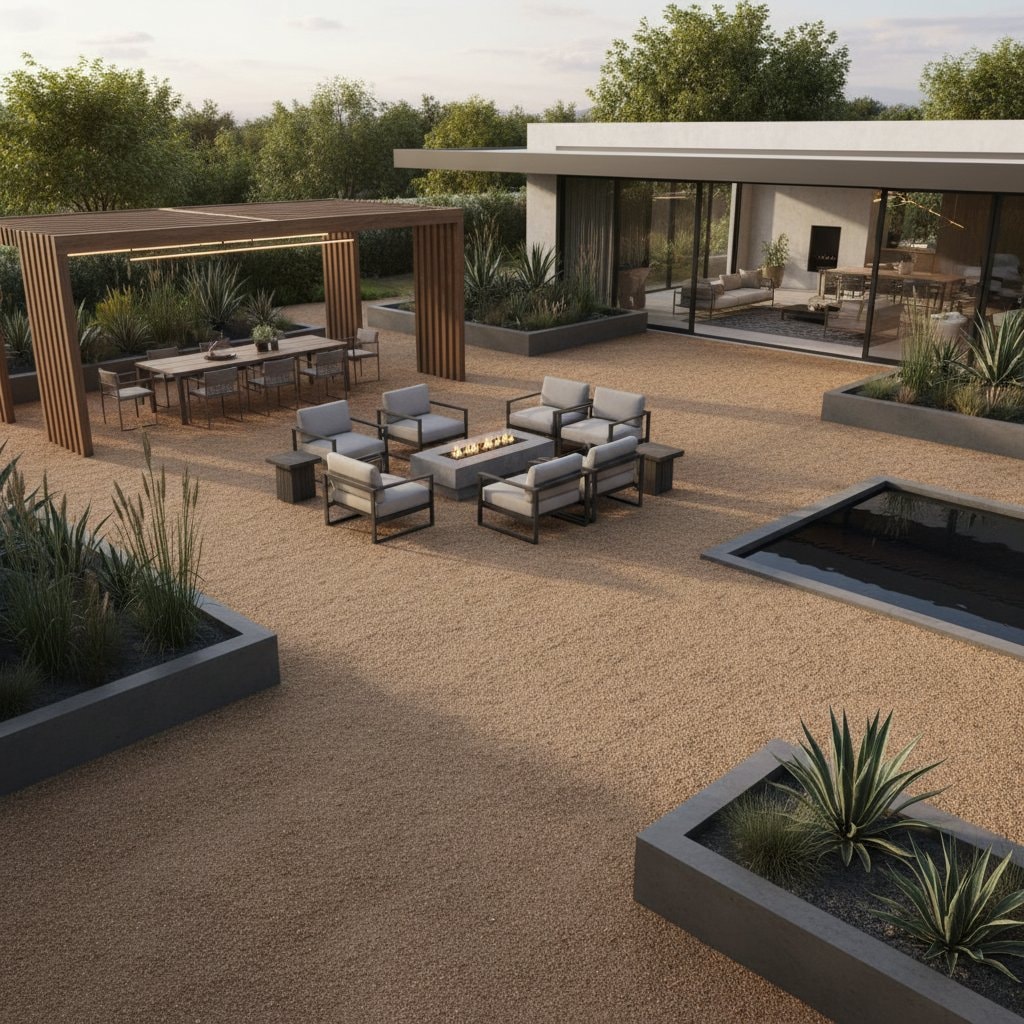
Current hardscaping preferences emphasize substances that evoke nature while delivering performance. Decomposed granite achieves this equilibrium, offering an unadorned, earthy appearance that harmonizes with concrete, timber, or rock features. Its seamless expanse supports fluid transitions between interior and exterior environments.
Employ decomposed granite independently for understated patios, or integrate it alongside pavers or flagstones to introduce visual interest. It enhances water-wise plantings, increasingly favored in arid climates. The subdued palette of DG accentuates foliage, emphasizing structural contours and tactile qualities.
Financial Considerations and Setup Process
Cost represents a key factor in selecting decomposed granite. Material expenses typically range from one to three dollars per square foot. Professional installation elevates the total to four through ten dollars per square foot, influenced by regional labor and terrain specifics. These figures undercut alternatives like concrete or quarried stone, which often exceed twenty dollars per square foot.
The setup procedure proves accessible. Begin by excavating current soil to a depth of four to six inches. Install and compact a gravel base for stability, then distribute the decomposed granite in layers of two to four inches, compacting each thoroughly. Incorporate a stabilizer, available as a liquid additive or powder, to enhance cohesion and weather resistance.
Most projects span two to three days, scaled to area dimensions. The material's light weight facilitates rapid distribution, outpacing the timelines for concrete pouring or paver alignment. Individuals inclined toward self-directed efforts find this among the more manageable hardscaping endeavors, provided they secure appropriate implements like a plate compactor and edging restraints.
Upkeep and Durability
Decomposed granite surfaces demand minimal attention, though periodic intervention preserves optimal condition. Over years, minor depressions or dispersals may occur; address them by replenishing with fresh material and recompacting. For stabilized variants, refresh the binder every three to five years to sustain integrity against wear.
Organic accumulation can foster weed growth. Install geotextile fabric beneath the foundation to inhibit intrusion, and maintain cleanliness through sweeping or leaf blowing. With adequate slope for runoff and secure borders, these patios endure for twenty years or longer, seldom requiring extensive intervention.
Sensory and Functional Advantages
Stabilized decomposed granite provides a agreeable tactile experience. It absorbs heat less intensely than concrete under sunlight, and its porosity prevents water accumulation. These traits suit regions with occasional precipitation or sprinkler overflow, while diminishing reflective light common in pale surfacing.
Position outdoor furnishings and appliances steadily on the surface, though protective pads beneath supports avert impressions. In high-use zones for meals or relaxation, embed concrete slabs or stones for reinforcement. Define boundaries with metal strips, bricks, or boulders to confine the aggregate and uphold tidy contours.
Ecological Advantages
Decomposed granite ranks among the most sustainable patio options. Sourced naturally and often nearby, it minimizes transport emissions. Its permeable nature facilitates rainwater infiltration, replenishing aquifers and curbing surface erosion over impervious coverings.
Production avoids high-energy processes, yielding a reduced environmental impact compared to cement or modular units. Opting for DG advances eco-conscious landscaping, diminishing reliance on manufactured composites and promoting biodiversity in yard designs.
Decomposed Granite Versus Alternative Surfacing
Evaluating decomposed granite against prevalent patio choices highlights its strengths.
- Concrete: Offers endurance and evenness, yet incurs high expense and risks fissures. Decomposed granite provides economy and simpler remediation.
- Pavers: Deliver charm and permanence, but demand intensive labor and funds. Decomposed granite approximates the allure with reduced complexity.
- Gravel: Presents low cost, though remains unstable for traversal. Decomposed granite achieves superior consolidation and assurance.
- Natural Stone: Exudes elegance, but burdens with weight and price. Decomposed granite mimics the organic allure affordably.
While each option serves distinct needs, decomposed granite excels in adaptability and efficiency for discerning property stewards.
Pitfalls to Sidestep in Implementation
Certain oversights can compromise a decomposed granite installation. Refrain from applying layers thinner than two inches, as they fail to bind adequately. Inadequate base preparation invites instability; always verify a four-inch gravel underlayment sloped at one percent for drainage.
Neglect of edging permits lateral spread, undermining uniformity. Select rust-resistant metal or pressure-treated lumber for containment. Test compaction with a tamper before final use to confirm even density across the expanse.
Steps to Implement Your Decomposed Granite Patio
To realize a patio embodying natural integration, modern flair, and fiscal prudence, proceed methodically with decomposed granite. Measure the intended area precisely, then compute material volume using online calculators or supplier guidance, accounting for ten percent excess. Assess site conditions, including soil type and sunlight exposure, to select the optimal color variant.
Determine involvement level: enlist certified landscapers for intricate terrains, or embark on DIY with rented equipment for level grounds. Source quality decomposed granite from reputable outlets, verifying stabilizer compatibility. Post-installation, monitor initial settling and adjust as needed to ensure lasting performance.
A completed decomposed granite patio fosters an engaging, resilient outdoor domain. Its understated sophistication elevates everyday enjoyment, harmonizing with evolving landscapes while delivering enduring utility.